What God Is Showing Me…
Part Two of a Three-Part Biblical Teaching Series
By Superintendent Dr. Gary L. Cordon, Sr.
Hebrews 4:15–16 (KJV)
15 For we have not an high priest which cannot be touched with the feeling of our infirmities; but was in all points tempted like as we are, yet without sin.
16 Let us therefore come boldly unto the throne of grace, that we may obtain mercy, and find grace to help in time of need.
The Jar Was Still Closed
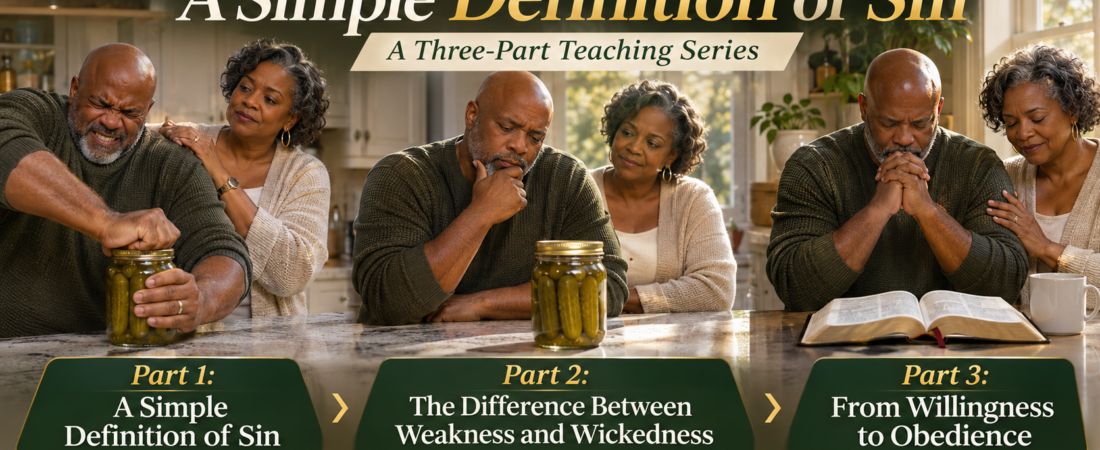
In our previous lesson, I shared an experience that occurred when my wife asked me to open a jar. I tried repeatedly, but the lid wouldn’t budge. Eventually, I stopped trying. And because I couldn’t open it, I decided that I didn’t want to open it anymore!
That experience reminded me of something important about sin: sometimes what begins as inability becomes unwillingness. But now consider another question. Was my inability to open the jar a moral failure?
Of course not! I had encountered a limitation. I was unable to accomplish something I genuinely wanted to do. The fact that I couldn’t open the jar didn’t make me a bad husband. It didn’t make me wicked. It certainly didn’t mean that I was living in rebellion against God!
Every weakness is not wickedness. Every difficulty is not disobedience. And every temptation is not sin. We need to understand these distinctions if we are going to grow spiritually without becoming either careless about sin or unnecessarily condemned by our weaknesses.
1. There Is a Difference Between Human Limitation and Moral Disobedience
God created us as human beings. We have physical limitations. We become tired, experience frustration, and sometimes misunderstand situations. We are not all equally gifted, equally strong, or equally capable. There are circumstances in which our best efforts are simply not enough. But limited human ability is not the same thing as sin.
Psalm 103:13–14 (KJV)
13 Like as a father pitieth his children, so the LORD pitieth them that fear him.
14 For he knoweth our frame; he remembereth that we are dust.
God understands our humanity. He knows our limitations and is not surprised by our frailty. However, we must not confuse God’s compassion for our limitations with permission to knowingly disobey Him. Human limitations may explain why something is difficult; they do not automatically justify sinful decisions.
We must distinguish between what we cannot do because of genuine limitations and what we refuse to do because our hearts are resistant to God.
2. There Is a Difference Between Temptation and Sin
Being tempted does not necessarily mean that you have sinned. Jesus Christ Himself was tempted, yet He never sinned.
Hebrews 4:15 (KJV)
“For we have not an high priest which cannot be touched with the feeling of our infirmities; but was in all points tempted like as we are, yet without sin.”
Notice those final words: “Yet without sin.” The presence of temptation does not prove that we have surrendered to it. An unwanted suggestion may enter your thoughts. An opportunity for wrongdoing may present itself. You may experience pressure to respond in a way that violates God’s Word. Temptation is not the same thing as choosing to disobey.
James 1:14–15 (KJV)
14 But every man is tempted, when he is drawn away of his own lust, and enticed.
15 Then when lust hath conceived, it bringeth forth sin: and sin, when it is finished, bringeth forth death.
The danger is not simply that temptation appears. The danger is that we entertain, embrace, and yield to sinful desire. We must not deliberately cultivate what God has commanded us to resist. But neither should we condemn ourselves simply because we have experienced temptation. Turn to God, resist what is evil, and seek His help.
3. There Is a Difference Between Stumbling and Settling Into Sin
A believer who knowingly commits sin must not excuse that sin merely by calling it a weakness. Sin remains sin. However, there is a difference between a person who falls and responds with genuine repentance and someone who deliberately embraces wrongdoing while resisting God’s correction.
Consider the Apostle Peter. Peter loved Jesus and sincerely believed that he would remain faithful. Yet when pressure became overwhelming, he denied knowing the Lord three times. That denial was sinful; it wasn’t merely an innocent mistake. But Peter’s story did not end with his failure.
Luke 22:61–62 (KJV)
61 And the Lord turned, and looked upon Peter. And Peter remembered the word of the Lord, how he had said unto him, Before the cock crow, thou shalt deny me thrice.
62 And Peter went out, and wept bitterly.
Peter recognized what he had done. His heart was broken. He did not celebrate his denial, establish a new doctrine to justify it, or argue that denying Jesus was acceptable because circumstances were difficult. Peter repented. Later, in John 21, Jesus restored Peter and recommissioned him for service.
Peter’s failure was serious, but his failure was not the end of his story. The grace of God met a repentant man. The man who denied Jesus would later stand boldly and proclaim Him. What a difference the power of the Holy Ghost makes!
4. Weakness Needs Help; Wickedness Requires Repentance
Weakness can expose us to temptation, but weakness does not automatically excuse sinful behavior. When weakness leads us into sin, we need both repentance and God’s strengthening grace. When a person deliberately chooses evil and refuses correction, the problem is more than inadequate strength: the heart needs to turn toward God.
One person says, “Lord, I know what Your Word requires. I am struggling, but I want to obey You. Please help me.” Another says, “I know what God’s Word says, but I have decided that I am going to do what I want.”
Those statements reveal different postures of the heart. The first expresses dependence upon God. The second expresses deliberate resistance to His authority. God calls both people to holiness, but their immediate spiritual needs may differ. One may need encouragement, accountability, instruction, and strength. The other must confront a will that resists God’s correction. Both need the grace of Jesus Christ.
5. God’s Grace Is Not Permission to Sin
Grace is not permission to remain unchanged. Grace is God’s provision for salvation and holy living.
Titus 2:11–12 (KJV)
11 For the grace of God that bringeth salvation hath appeared to all men,
12 Teaching us that, denying ungodliness and worldly lusts, we should live soberly, righteously, and godly, in this present world;
Grace teaches us to deny ungodliness, reject worldly lusts, live righteously, and live godly in this present world. That’s holiness! Biblical holiness is not an attempt to earn salvation through religious performance. It is the life God calls us to live as we respond to His saving and transforming grace.
We cannot excuse sin by claiming that everyone has weaknesses. But neither should we teach believers that every experience of struggle proves they are hopelessly defeated. Jesus Christ is our Savior and the source of our strength.
6. What Should We Do When We Fall?
1 John 1:9 (KJV)
“If we confess our sins, he is faithful and just to forgive us our sins, and to cleanse us from all unrighteousness.”
Notice what God promises: forgiveness and cleansing. He doesn’t merely forgive our wrongdoing and leave us unchanged. He offers cleansing from unrighteousness.
1 John 2:1 (KJV)
“My little children, these things write I unto you, that ye sin not. And if any man sin, we have an advocate with the Father, Jesus Christ the righteous:”
Notice the balance. The expectation is that we do not sin. But if we do, we have an Advocate—Jesus Christ the righteous. That is not permission to sin. It is assurance that a repentant believer can return to God through Jesus Christ. The grace that forgives us is also the grace that enables us to grow.
What God Is Showing Me…
“God does not confuse your humanity with rebellion, but neither should you confuse rebellion with humanity.”
“The evidence of repentance is not that you never struggled. It is that you stopped defending what God was calling you to surrender.”
Stop condemning yourself for limitations that God never declared sinful. But do not use your limitations to justify what God has declared wrong. There is a difference between needing help and refusing help, between being tempted and yielding to temptation, and between stumbling in weakness and settling into deliberate disobedience.
Remember: “You can’t do wrong long if you intend to do right.” Genuine intention must lead us toward repentance, surrender, and obedience—not simply repeated promises without change. God is faithful to help those who sincerely seek Him.
Personal Reflection
- Have I been condemning myself for weaknesses that are not necessarily sins?
- Have I been calling something a weakness when God has been confronting me about deliberate disobedience?
- When I fail, do I respond with repentance and renewed dependence upon God, or defend my actions?
Closing Prayer
Father, thank You for understanding our humanity while calling us to holiness. Help us recognize the difference between weakness, temptation, and sin. Deliver us from unnecessary condemnation, but never allow us to become comfortable with disobedience. Give us repentant hearts, renewed minds, and the courage to receive Your correction. We thank You for the forgiveness and cleansing available through Jesus Christ. In His name, Amen.
Coming Next: From Willingness to Obedience
Knowing what is right is important. Wanting to do what is right is even better. But how do we move from wanting to obey God to actually living in obedience? That is where the transforming power of the Holy Ghost becomes central.
Continue Growing With Us
Thank you for reading What God Is Showing Me… Explore more biblical teachings, spiritual growth resources, and ministry opportunities at PastorCordon.org. Connect and subscribe, explore the resource library, and support this teaching ministry.
Superintendent Dr. Gary L. Cordon, Sr.
Senior Pastor, The Evidence Churches — One Church • Two Locations
Superintendent, The Historic Edenton District COGIC
Our Mission: Win Souls, Keep Souls, Train Souls to Win Souls!